
A Glimpse into My Journey
Grab some popcorn and make yourself comfortable.
When I was around 6 years old, all my friends had a Commodore 64. Every visit to their homes was a chance for me to marvel at the technology before me. We played video games, but my curiosity led me to wonder how it all worked, from the load commands to those mysterious arguments. Opportunities to learn were scarce since those were not my own computers. However, about a year or two later, I stumbled upon a local education club for kids. It offered a woodworking program, but more importantly, it had about ten C64 units and one floppy drive. There were also two cassette decks and a flash module for turbo loading from tapes. Although I spent most of my time playing games, these computers were often busy, so I had to wait.
One day, an older boy took me to a seldom-used computer called the Orao. I didn't know it at the time, but it was a locally manufactured computer powered by the MOS 6502 processor and ran on the ORAO Basic operating system. The boy handed me a sheet of paper filled with gibberish and asked me to type it into the computer. When I finished, he showed me how to run the code. I didn't even know English, let alone what code was, but I was amazed when a couple of circles appeared on the screen. He told me I had created those circles and encouraged me to experiment by changing numbers in my code. I was fascinated by my newfound ability to make the computer draw any-sized circle I wanted.
As time passed, the available games on the C64 started to feel somewhat dull, so I began coding for it. One of my early programs mimicked a chatbot, asking users questions and responding with predefined sentences that used their answers as variables. It was my earliest attempt at creating something like ChatGPT, albeit a much simpler version. I remember it vividly to this day.
Finally, my father brought home long-awaited news. He had purchased a computer for me in 1992, when I was 11 years old. I can't adequately describe the joy I felt at the time. The computer was an Amiga 500 Plus. Unboxing it revealed a challenge – we had no way to connect it to our color TV. Eventually, we found a SCART cable, but it turned out to be incompatible. Undeterred, my father decided to buy a proper monitor, and we found a secondhand Commodore 1084s with an RGB cable. When we set it up and powered it on, it was a revelation.
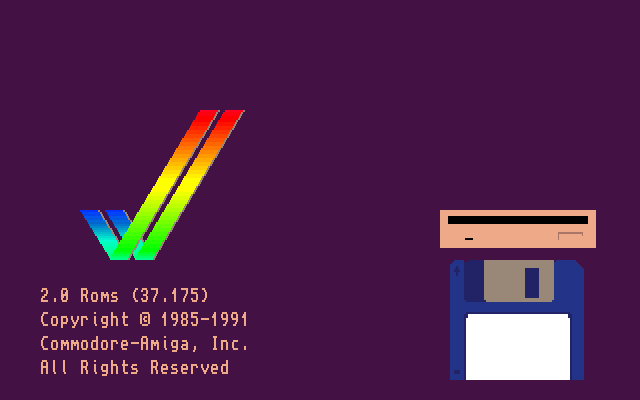
The next five years left an indelible mark on my life.
So. Many. Games. If you're reading this, you probably understand how pivotal the Amiga was for video games. It also made a significant impact in various other computing areas, such as drawing, music, ray tracing, and more. I cherished my newfound Amiga superpowers with great joy and beautiful nostalgia. There was no doubt in my mind that my father had bought me the best computer in the world—until my friend got an Amiga 1200, that is. I couldn't help but envy him.
Where were we? Ah, yes, video games. Countless favorites come to mind without checking the list: Cannon Fodder, Monkey Island, Beneath The Steel Sky, Pinball Fantasies, It came from the Desert, Sensible World of Soccer, Bubba'n'Stix, Superfrog, ZOOL, The Lost Vikings, Bubble Bobble, Turrican II, Behind the Iron Gate, Settlers, Dune, Lemmings... The list feels endless.
Then there was Deluxe Paint, where I created many artworks. I even purchased a nine-needle matrix printer with my own pocket money. I also bought an external floppy drive to simplify gaming experiences that required frequent disk swapping.
Next came Amos Professional. I taught myself to code on the Amiga. While I may not be exceptionally proud of what I learned, it was incredibly fun to create things.
My love for the Amiga extended into the early days of PC gaming, and I finally got my first PC in 1997.
So, how did we arrive at the year 2023, and why does this webpage exist?
I'm not entirely sure how it happened, but in 2022, a burning desire rekindled within me to acquire the amazing Amiga 1200 I couldn't afford 30 years ago. I started researching, connecting with Amiga streamers on Twitch, asking questions, and joining various Discord servers. Through these interactions, I discovered the vibrant Amiga scene that continues to thrive today. The Amiga operating system receives regular updates, which is astonishing after three decades. I also learned about the exciting hardware mods and began envisioning the future of my Amiga, considering what upgrades I would install. What truly blew my mind was the fact that game developers were still creating new games for the Amiga. It was beyond my wildest imagination. Additionally, I found people actively teaching how to code for the Amiga in Amos, Assembly, and Blitz. Each of these communities is thriving, and it appears that there are countless active Amiga enthusiasts out there.
The price of entry for an Amiga 1200 initially seemed steep, so I contemplated settling for another Amiga 500. Eventually, I stumbled upon a working Amiga 600 unit, but I finally decided to fulfill my lifelong dream. I ordered a refurbished Amiga 1200 from England and paid import taxes to the EU. I also purchased a QuickShot joystick and a Gotek drive to kickstart (no pun intended) my journey.
The SCART to HDMI signal converter I bought on AliExpress turned out to be a disappointment. I connected my Amiga directly to my living room LCD via SCART, which, although cumbersome with all the cables, was a starting point. Soon after, I acquired a 14" Sony Trinitron, thanks to my friend Robert who bought it for us when I was cashless. Thank you, Robert.
So, where do we go from here?
I aspire to contribute to the Amiga community. This is my primary goal. While I may not be able to create a video game (though I will try), or design new hardware expansions for Amiga, I am a content creator. I can document my journey and write about the experiences I encounter. From getting Amiga up and running to installing the operating system, setting up a hard drive, and using Gotek—there will be a plethora of how-to guides in one place, all geared towards beginners, ensuring that those who follow my steps will have ample resources.
One of my wishes is to acquire as much Amiga equipment as possible to write about. If you find my writing valuable, I would appreciate a small boost to my morale on my Ko-fi page (link below). I also host a Mastodon instance for gamers, which my Ko-fi page will provide more information about, although that's beyond the scope of this write-up.